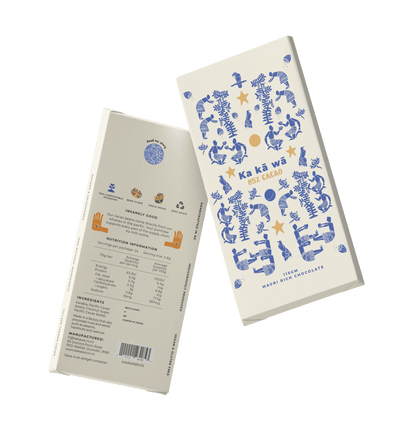
Ka kā wā works with cacao from three places and names all of them: Papua New Guinea, Solomon Islands, and Vanuatu. Not a blend, not a region left vague on the back of the pack, and not a fourth origin held in reserve. Three. This article is what those names mean, why the Pacific is worth paying attention to, and what naming an origin commits a maker to.
Why the Pacific at all
Cacao grows in a band roughly twenty degrees either side of the equator, which puts the Pacific islands squarely in it. The region is a small share of world production, which means Pacific cacao rarely ends up in supermarket chocolate, where volume decides everything. For a small maker the calculation runs the other way: small lots, closer relationships, and a growing region that sits in the same ocean as Aotearoa.
Papua New Guinea
Papua New Guinea is the largest cacao producer of the three and has a long history with the crop, grown mostly by smallholders rather than plantations.
Solomon Islands
Solomon Islands cacao is grown across scattered island communities, again at smallholder scale, which means a single origin can sit across a good deal of ocean.
Vanuatu
Vanuatu is the smallest cacao producer of the three, and its cacao is valued among craft makers well out of proportion to the volume grown.
What origin actually changes
Two bars at the same percentage from different origins can taste noticeably different. Some of that is the cacao itself, and a great deal of it is what happens at origin before the seeds ever reach a maker: the terrior, how they are fermented, for how long, and how carefully they are dried. Fermentation in particular creates an enormous amount of the flavour that survives into the finished bar, which is why the origin deserves naming rather than being treated as an anonymous commodity.
What we can and cannot tell you
We will not print a flavour wheel we cannot stand behind. Tasting notes for each bar come from the current pack copy, and if a descriptor is not there, we have not invented it. The most reliable way to find the difference is still to taste two origins side by side and trust your own palate ahead of anyone else's adjectives.
Frequently asked questions
Where does Ka kā wā cacao come from?
Three Pacific origins: Papua New Guinea, Solomon Islands, and Vanuatu. Every bar names its origin.
Is Pacific cacao different from South American cacao?
Growing conditions, varieties and post-harvest practices all differ by region, and those differences show up in the cup. Pacific cacao is also far less common in mainstream chocolate, simply because the volumes are smaller.
Why only three origins?
Three is what Ka kā wā can work with properly. Each origin needs its own roast and its own handling, and that attention does not scale indefinitely.
Is it single origin or a blend?
Single origin. Each bar is made from one named origin rather than blended to a house flavour.
Do the origins change from batch to batch?
Cacao is agricultural, so harvests vary. The three origins stay the same.